
Biomass gasification produces a combustible gas from agricultural waste, wood waste and other organic matter. This gas can be used for a range of industrial applications. However, this raw gas may contain other materials such as dust, moisture and organic condensed liquids (tar).
As this gas cools, some of these materials will start to condense creating a sticky residue in piping, filters, heat exchangers etc. This can cause blockages, pressure drops, reduced heat transfer and increase maintenance.
To effectively remove tar from the gas produced during biomass gasification, it is important to control tar formation within the reactor, choose the correct gas cleaning methods and manage the gas correctly.
Understanding Tar Formation in Biomass Gasification
Tar is formed during the gasification process which consists of thermal decomposition and gasification of biomass. It is a complex mixture of condensed organic compounds. Depending on the feedstock used, tar can be made up of Phenols, Aromatic Hydrocarbons (e.g Toluene) and Polycyclic Aromatic Hydrocarbons (PAHs).
Biomass gasification consists of several steps: Drying, Pyrolysis, Oxidation & Reduction. During pyrolysis, organic matter is thermally decomposed in low oxygen environments. This produces a range of volatile gases and vapours. Some of these will then go on to form tar.
As this gas moves through hotter regions of the reactor some of this tar will be decomposed or reacted with the steam, CO2 and other products. However, some tar will still remain in the producer gas depending on the temperature, residence time and gas-solid conditions.
The amount and type of tar created will be dependent on both the feedstock properties, gasifier design, temperature and conditions.
Why Tar Creates Problems in Industrial Gasification Systems
Tar can create problems when the gas is cooled during transport or cleaning. This will cause the tar to condense and create a sticky residue. This can cause issues such as blockages in pipework.
Tar can cause issues in several pieces of equipment within an industrial plant. Heat exchangers may see a reduction in performance due to fouling. Filters can block and cause pressure drops whilst gas engines may have issues with deposits and performance due to the gas not meeting the manufacturers fuel requirements.
How much of an issue this will cause will depend on the type of tar, concentration, gas temperature and downstream equipment. The gas may be suitable for combustion in a properly designed furnace but may not be clean enough to use in an internal combustion engine or chemical process.
Therefore, gas cleaning should be designed according to the end use.
Factors That Influence Tar Formation
Considering the feedstock, reactor design and conditions can help to manage tar formation. Engineers should consider all of these factors when designing a system to manage tar.
Gasification Temperature and Residence Time
Temperatures will impact how much of the tar compounds are broken down. Increasing the temperature can help to increase tar decomposition and reforming reactions under the correct conditions. However, increasing the temperature of the gasifier may not always be feasible. This may increase energy requirements and can effect material choices and ash behaviour.
Residence time is how much time the gasses and vapours are in a certain region of the reactor. This can help to increase the amount of tar converted if the gas is at the correct temperature for a sufficient amount of time. If the gas is moving through too fast there may not be enough time for all the tar to be decomposed.
Biomass Moisture and Feedstock Characteristics
High moisture content will increase energy requirements to heat the biomass to initiate gasification. It can also affect the temperature profile and stability of the reactor.
Particle size, bulk density, volatility, ash content and consistency will affect the reactor. Inconsistent particle sizes/ moisture levels can cause inconsistent gas flow and can lead to unstable conditions. Therefore it is important to consider how the feedstock is prepared, screened and dried.
Reactor Design and Operating Conditions
Depending on the type of gasifier used, you will have different temperature profiles and gas flow. For example, updraught and downdraught fixed bed gasifiers will have different interactions between the biomass, gasifying agent and producer gas. Fluidized bed gasifiers operate with different gas solid mixing patterns and heat transfer characteristics.
Gasifying conditions such as equivalence ratio, gasifying agent, bed temperature and gas velocity will affect the reactions inside. Conditions should be set according to the gasifier and feedstock.
Industrial Methods for Tar Removal and Reduction
In industrial applications, tar is typically managed through two main approaches: primary methods that minimize tar formation within the gasifier and secondary methods that remove tar from the producer gas.
Primary methods to manage tar formation include managing the temperature, improving feedstock preparation, optimising gas flow and using the correct bed materials/catalysts. This can help reduce the amount of tar on downstream equipment. However, this may not give the gas the correct quality for all applications.
Secondary methods to manage tar include thermal, catalytic, wet scrubbing and selective filtration/separation. Each of these methods will work differently and depend on the type of tar, gas temperatures, contaminant levels, energy requirements and end use.
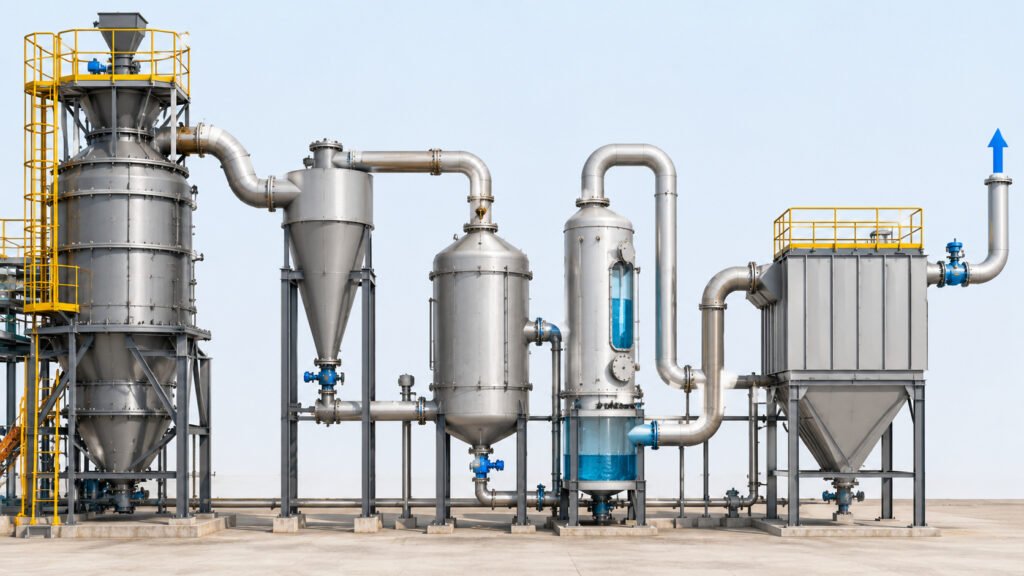
Thermal cracking can break down the heavy tar compounds using high temperatures. This will produce lighter compounds. This can help reduce the amount of tar but may not produce enough to put into a liquid waste stream. The temperature and residence time should be suitable and extra energy may be required. When designing your system you should consider the energy requirements, materials and costs.
Catalytic tar cracking uses materials such as Dolomite, Olivine or specific Nickel based catalysts to help decompose and reform the tar. This can help decompose the tar at lower temperatures using catalysts. The catalyst will depend on the gas composition, conditions and desired conversion. Performance will decrease over time due to carbon build-up, poisoning and deterioration. Therefore you should consider how often you will need to replace, regenerate and maintain.
Wet scrubbing involves contacting the producer gas with a liquid to remove specific contaminants. This can help remove condensed tar and some particulates depending on the design and liquid used. This can be a good option as it helps cool the gas. However, it will create contaminated liquids with the organic compounds captured. You will need to consider how to treat the waste water, circulate the liquid and dispose of it.
Separation and filtration methods can help remove particulates, droplets and select aerosols. Large particulates can be separated using cyclones. Fine particulates can be captured using fabric or ceramic filters if they are operated correctly. Electrostatic precipitators may be used to capture fine droplets/aerosols if designed correctly. Different systems will have different separation abilities. Therefore you cannot assume a regular cyclone/filter will remove all tar vapours. You may need a suitable conversion/condensation stage.
In many cases, a combination of technologies will be more suitable. For example, a cyclone may be used before a tar treatment stage. This can be followed by further cooling/filtration. The order will depend on the gasifier, characteristics of the raw gas and downstream requirements.
How to Select an Appropriate Syngas Cleaning System
Choosing the right syngas cleaning method will depend on what gas quality you require. Industrial burners and boilers may be more tolerant to contaminants than gas engines, turbines and chemical processes.
Engineers should understand what the raw producer gas contains. This includes temperature, particulate content, tar content, composition, moisture and any other relevant contaminants. Once you know the gas quality limits given by the manufacturer of the downstream equipment, you can design your system accordingly.
Hot gas cleaning will help keep more sensible heat in the gas. However, you will need equipment and materials that can handle the harsh temperatures. Cold gas cleaning is easier to implement but can create contaminated waste water. This will reduce the usable heat energy.
A full system may be required to remove particulates, convert/remove tar, cool, filter and condition the gas. You should consider capital costs, energy requirements, water usage, waste treatment, ease of maintenance and availability of replacement filters/catalysts.
Preventing Tar Condensation in Gas Pipelines and Equipment
Tar can condense in piping if the gas is cooled enough. This depends on the tar content and partial pressures. Managing the temperature of piping is an important consideration when designing your gasification system. Piping can be insulated to help reduce unwanted heat loss. Heat tracing may be considered to ensure the minimum temperature is maintained. If the gas is being cooled intentionally, you should have suitable condensate removal.
Low points, poor bends and poor drainage can cause a build up of liquid. You should consider how easy it is to inspect and clean. This will help reduce blockages and provide stable gas flow to downstream equipment.
Improving Gasifier Reliability Through Proper Tar Management
Monitoring the gasifier and full gas cleaning train will help ensure reliable operation. Measuring the temperature at key points can help identify any unstable operation. Pressure drops across filters and other equipment can indicate if there is a build up of dust/deposits.
Regular inspections of piping, drains, scrubbers, filters and heat exchangers will help identify early signs of fouling. Suitable gas sampling and analysis should be carried out to understand what level of tar and particulates are present. This is especially important if the downstream application requires strict fuel quality.
Consider how often maintenance will be required depending on operating experience, feedstock variability and equipment status. In continuous industrial operations engineers may consider having spare cleaning equipment or parallel filters so maintenance can be carried out without causing unnecessary disruption.
Conclusion
Managing tar is an important consideration when designing a biomass gasification system. If not managed correctly it can cause a reduction in gas quality, deposits in downstream equipment and increased operational/maintenance requirements. Managing tar effectively can be achieved by ensuring the feedstock is prepared correctly, gasifier is operated stably, correct conversion/removal technologies are used and piping is at the correct temperature.
There is no one size fits all cleaning method. The correct method will depend on the gasifier design, feedstock, gas quality requirements and end use. If the business requires bespoke process engineering solutions for biomass conversion and industrial energy, Kerone’s biomass gasification solutions can be considered. The gasifier and cleaning system should be considered together to ensure reliable operation.
Frequently Asked Questions
1. What causes tar formation in biomass gasification?
Tar forms when organic compounds released during biomass heating and pyrolysis undergo chemical reactions and remain as condensable hydrocarbons in the producer gas. Its formation is influenced by temperature, residence time, feedstock properties and gasifier design.
2. How can tar be removed from producer gas?
Tar can be reduced or removed using thermal cracking, catalytic cracking, wet scrubbing and suitable separation or filtration technologies. In practice, several methods may be combined to achieve the gas quality required by the downstream application.
3. Can cyclone separators remove tar from syngas?
Cyclones are mainly designed to remove entrained solid particles such as ash and char dust. They do not reliably remove tar that remains in vapor form. Additional tar-treatment equipment is generally needed.
4. What is the difference between thermal and catalytic tar cracking?
Thermal cracking uses heat to break down tar compounds, while catalytic cracking uses a catalyst to promote chemical reactions that convert tar. Catalytic systems may operate at lower temperatures than thermal-only systems, but catalyst activity can decline through contamination or carbon deposition.
5. How can tar condensation in gas pipelines be prevented?
Pipeline insulation, appropriate heat tracing, controlled gas cooling and properly designed condensate drainage can reduce condensation-related problems. The required temperature should be established from the gas composition and system operating conditions.
6. Does biomass moisture content affect tar formation?
Yes. Moisture influences the energy required for drying and can affect reactor temperature distribution and gasification stability. Feedstock moisture should be controlled within the operating range established for the gasifier.
7. Is wet scrubbing suitable for every biomass gasification plant?
No. Wet scrubbing can be useful where gas cooling and contaminant capture are required, but it creates a contaminated liquid stream that needs appropriate treatment and disposal. Hot gas cleaning or other dry methods may be more suitable for applications where retaining gas heat is important.
8. Why does tar cause problems in gas engines?
Tar can condense and form deposits on engine components, affecting reliable operation and increasing maintenance requirements. Gas supplied to an engine must meet the manufacturer’s limits for tar, dust, moisture and other contaminants.