
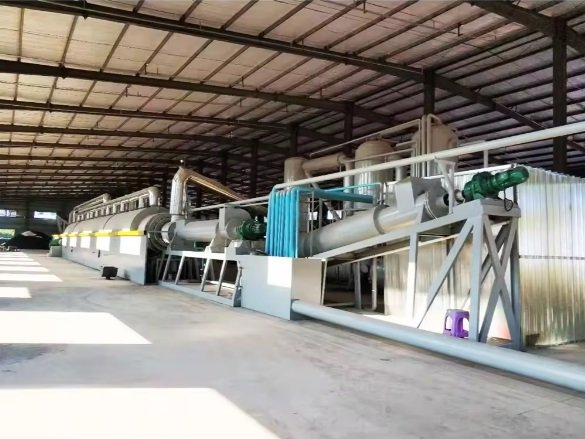
The continuous pyrolysis plant in Kerone seeks to constantly transform additional black pollutants into energy. Oil is produced at this facility from rubber, plastic, and tire. Waste management has been a focus of numerous governments and investors. Considering that garbage cannot be processed in big numbers in an environmentally responsible manner. To treat garbage without creating pollution, this kind of machine is a perfect option. Kerone continuous type offers a plethora of considerable benefits, including a high rate of safety and a high cost to performance ratio, among others.
A wide range of pyrolysis plant types use continuous pyrolysis plants. Comparing continuous pyrolysis plants to batch or semi-continuous plants, continuous pyrolysis machine have a bigger single-machine capacity, reduced work intensity, and continuous continuity. The continuous pyrolysis system’s equipment and numerous components have a very complicated design, necessitating the matching of the equipment and the capacity to automatically manage it. This allows the continuous pyrolysis plant to operate with a high degree of efficiency and stability.
A modern industrial facility called a continuous pyrolysis machine was created for the automated and continuous thermal conversion of a variety of organic resources into marketable products. Processing waste rubber, plastic, and biomass with this cutting-edge system can help with resource scarcity issues and environmental concerns.
Due to the structural limitations of the continuous pyrolysis plant, it can only be used in workshops or large or medium-sized refineries. Additionally, compared to batch pyrolysis plants, continuous pyrolysis plants have relatively significant investment costs and fall under the category of big and medium-sized continuous pyrolysis system.
A continuous pyrolysis system is fundamentally made up of a number of essential parts, such as a feeding system, a preheating chamber, a pyrolysis reactor, a vapor separation unit, gas utilization equipment, and systems for collecting solid residue and storing finished products. Beginning with the continuous input of raw materials, which are later warmed to remove moisture and maximize the pyrolysis efficiency, the entire process proceeds without any interruptions.