
Although specification data may be provided for a carbonization unit (capacity, heating system, dimensions, and operating temps), it may be less clear how variability in feedstock will impact the performance of the process. In continuous biomass processing, the carbonization unit operates within a series of interconnected processes. Consideration must be made at preparation, feeding, heating, and discharge to ensure predictable biochar production.
Feedstocks can vary significantly depending on their source. For example, wood wastes, shells, husks, stalks and other agricultural waste feedstocks can differ in moisture content, particle shape, bulk density, ash content, and overall composition. Even for the same feedstock, variability can occur due to storage conditions, weather, handling or supplier variations. If system design assumes a standard ideal feedstock sample, the system may not perform as intended with the actual feedstock received.
Feedstock Variability Is a Design Input
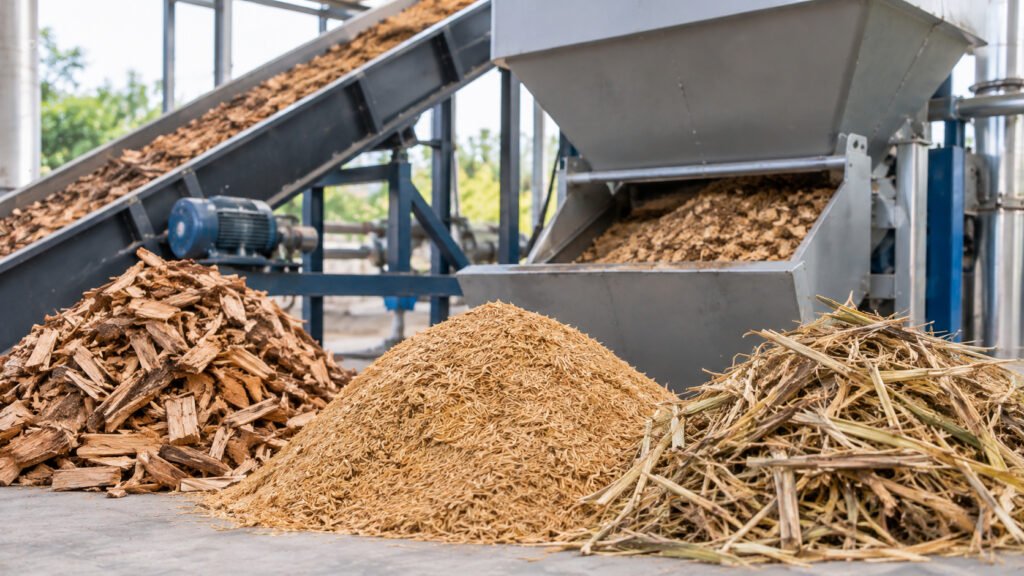
Variability in feedstocks will effect many aspects of system design. Moisture content will affect energy consumption during the drying phase. Bulk density will impact the mass of material fed per volumetric feed. Particle shape/size will impact feeding through hoppers/conveyors and rate of heating. If the feedstock contains long fibres bridging may occur. Excess fine material can cause compaction, dust issues and unpredictable flow.
Interactions between these properties can occur. High moisture and low bulk density material may exhibit different behaviour within a feeder than dry and high bulk density feedstock in the same system. Composition and mineral content in the feedstock may impact handling of residues, component wear, and biochar produced. Therefore, feedstock analysis should be considered as an engineering consideration.
Consideration should be made by project teams to evaluate whether the selected design for the carbonization unit can process feedstocks of the type expected by the business.
Preparation Sets the Conditions for the Process
Variability in feedstock can be minimised, controlled, or passed onto downstream processing. Depending on feedstock type and unit design, preparation can include reducing particle size, sieving, contaminant removal, moisture adjustment, drying, or mixing. It is not intended to provide the same preparation for all feedstock types, just to allow for consistent feedstock into the carbonization unit.
Reducing particle size can improve consistency. However, excess grinding can be costly in terms of energy input and cause issues with storing, feeding and dust. Sieving can allow oversized and problematic contaminants to be removed. Drying may reduce energy requirements within the carbonization process however will require additional equipment with increased energy demand and complexity. Whether this is beneficial should be assessed in line with feedstock moisture content, available heat, process requirements and project economics.
Similarly, providing storage and mixing may be very important. This can help to reduce short term variability between batches of feedstock, allowing for a more predictable feed. Target moisture and particle size must be defined based on the technology and product type.
Material Handling Is Part of Thermal Control
Material feeding and handling in a continuous carbonization process has implications for thermal demand in the unit. The heating system is designed for a specific feed rate and material type. Variability in feed rate or pausing of feed can alter thermal demand in the reactor.
Blockage in hoppers, choke in screw feeders, uneven flow, and compaction may occur. Fibre rich or moist feedstock may cause different material handling issues to dry, granular feedstock. Consideration should be made for hopper design, material transfer points, type of feeder, sealing and ease of cleaning. If low oxygen atmosphere is required within the process, inlet/outlet sealing must allow for efficient material handling, whilst preventing unwanted oxygen ingress.
If material handling issues occur, it may be indicated by changes in temperature, inconsistent products, or increased manual intervention. Using feedstock flow and process information can help to understand why an issue may be occurring.
Heat Transfer, Residence Time and Product Quality
Efficient carbonization occurs based on thermal energy, temperature, and residence time. Particle size, moisture content, and structure will impact thermal transfer within a particle. Larger or moist particles may cause temperature gradients. Uniform thermal conditions experienced by particles depend on reactor unit design and material flow.
Within a continuous reactor, residence time variations may occur. This means that a range of residence times are experienced by feedstock. If this range is large enough to affect the desired product, some feedstock may not be sufficiently converted, whereas other feedstock may receive excessive thermal energy. Due to variability in feedstock and process parameters, different products may be produced depending on feedstock. Parameters chosen for one feedstock may not produce the desired product for a different feedstock.
A stable operating window should be determined for the feedstock and desired biochar, based on thermal behaviour, material flow, and control of the unit. Although heat recovery from process streams can improve energy efficiency, this will have implications on other subsystems and should be considered as part of the plant operating strategy.
Automation Helps Manage a Process-It Cannot Fix Its Design
Control systems allow operators to monitor conditions which may be difficult to observe. Observing temperature profiles, feed rate, motor loading, pressure where appropriate, unit status, and discharge profiles allow deviation to be identified and corrected. As trends can be observed, less reactionary control from operators may be required.
However, there are limitations to control systems. If feedstock is unsuitable for the unit, poorly prepared, inconsistent feed from feeder equipment, or there is a bottleneck in the system, the control system cannot be relied upon to compensate. Sensor instrumentation in dusty and/or high temperature environments should be properly fitted, inspected, and calibrated. Best results are achieved if control systems support a well designed and maintainable process.
Stable material and thermal conditions should be prioritised in system design, and control systems used to support these.
Evaluate the Plant as a Connected System
Although capacity is an important specification in projects, it should not be the sole metric. If running near nominal maximum levels, there may be less flexibility to cope with feedstock variability and increased wear on feeding/discharge systems. This could mean that if maintenance is required, productivity may be disrupted greatly. Alternatively, a system running predictably and consistently at a feasible rate, to produce biochars of the correct specification and easily maintainable, may give more reliable yearly production.
Within a biomass carbonization plant, care should be taken to consider the following in relation to the feedstock: assumptions made in design, preparation requirements, feeding and sealing methods, thermal design, heat recovery, monitoring, and maintenance access. If possible, trials using the intended feedstock can support verification of design assumptions and prevent them becoming limitations in operation.
Ultimately, continuous biomass processing should be considered as a system. To achieve consistent results, consistent feedstock must be delivered, appropriately prepared, fed, and heated to convert into biochar, and discharged. When considering building biomass processing facilities, businesses should consider the whole process, rather than simply the capacity of the carbonization unit, to understand how it may perform under realistic conditions. Thoughtful consideration of biomass processing and carbonization technologies can support decisions to be made based on practical feedstock considerations, predictable operation, and the desired product.
Frequently Asked Questions
1. Why does biomass feedstock variability affect carbonization more than it affects conventional fuel handling?
Carbonization is sensitive to heat and mass balance. Differences in moisture, particle size and density alter how much energy is needed, how fast particles heat up and how long they remain in the reactor. In simple combustion, these variations are partly absorbed by excess air and furnace volume. In an oxygen-limited process, they show up directly as changes in product quality and thermal stability.
2. What does continuous biomass carbonization require that batch operation does not?
A continuous system needs steady feeding, reliable sealing at the inlet and outlet, controlled residence time and discharge handling that can run without interruption. Batch units can tolerate more variation between cycles because each load is managed separately, while continuous plants must hold conditions stable over long periods. This puts more weight on preparation, material handling and control.
3. How much does moisture content matter in biomass thermal processing?
Moisture matters considerably, because water must be evaporated before material can reach carbonization temperatures, consuming energy and extending the heating stage. Large or sudden variations also disturb the thermal profile. The acceptable moisture range depends on reactor design and heat-recovery arrangements, so it should be specified with the equipment supplier for the intended feedstock.
4. Is size reduction always necessary in biomass feedstock preparation?
Not always. Some feedstocks, such as certain shells or pre-sized residues, may already suit the reactor, while others need crushing, chipping or grinding. The aim is a size range that heats evenly and feeds reliably. Excessive grinding is wasteful and can create fines that cause handling and dust problems.
5. What are the common causes of feeding problems in a carbonization plant?
Typical causes include bridging in hoppers, fibrous material tangling in screws, variable bulk density, moisture-related stickiness and foreign objects in the feed. Hopper geometry, feeder selection, vibration or agitation aids and upstream screening all influence the outcome. Feeding irregularities often show up first as temperature fluctuation rather than as a visible blockage.
6. Can automation compensate for inconsistent feedstock?
Only partly. Control systems can adjust heating, drive speeds or throughput within a designed range, but they cannot fix feed that is physically incompatible with the equipment. Automation is most effective when preparation and feeding already provide reasonably stable conditions, and when sensors are well maintained.
7. How does residence time influence biochar quality?
Residence time, together with temperature and heating rate, affects how completely volatile matter is released and how the carbon structure develops. Too short a time can leave under-carbonized material, while too long can reduce yield or alter properties. Because particles in a continuous reactor do not all move identically, the residence time distribution is as important as the average.
8. What should project developers examine beyond rated capacity when evaluating an industrial biomass carbonization plant?
They should look at feedstock adaptability, the preparation steps assumed in the design, feeding and sealing arrangements, heat recovery, maintenance access, spare-part requirements and expected availability. Reference operations using comparable biomass, and trials on the intended feedstock, give more useful evidence than a headline capacity figure.
9. How does heat recovery affect plant stability?
Using process gases or waste heat for drying or reactor heating can improve energy efficiency, but it couples subsystems together. Changes in feedstock moisture or volatile content then affect available heat, which in turn affects drying and reactor conditions. Well-designed plants account for this with buffering, supplementary heating or control strategies.
10. What maintenance factors influence long-term biomass plant performance?
Wear in feeders, conveyors, seals and discharge systems, deposit build-up on thermal surfaces and the reliability of instrumentation all affect availability. Abrasive or high-ash feedstocks accelerate wear. Planning for inspection access, replaceable wear parts and routine cleaning is part of designing a plant that can run continuously.