
The pellet mill is operating at its maximum capacity, with a newish die. Output is as expected, however there is a lot of fine dust in the bagging area. The fines bin is filling fast, and we have had a delivery returned due to poor durability. Many plants will see this as a problem with the biomass pellet machine. We will play around with the rollers and change the dies.
However, the issue may be down to something else. Uneven moisture levels, bad particle size, fast cooling, harsh conveying or poor screening can all cause good quality pellets to become dusty. This causes losses in yield, rejections and a dusty unsafe working environment. This article will explain where the issue with your pellets begins, and how to find out what stage it is happening at. We will also explain how having the right equipment throughout the process (grinding, cooling, screening) will keep the fines down.
Pellet Dust Is a Line-Wide Symptom, Not Only a Pellet Mill Fault
If you’re trying to solve your dust issue but aren’t identifying where the fines are being produced, you’ll be wasting time and money.
What Fines Are and Where They Come From
Fines are very small particles and fragments that are smaller than the minimum size for your pellet. They are generally expressed as a % of your output. Quality of your product will depend on the mechanical strength of your pellet. There are certain standards (ENplus) that dictate maximum amounts of fines and many purchasers have their own standards too. There can be two causes for fines. Material that doesn’t bond and pellets that do bond but then break during cooling or handling. You’ll need to identify where the fines are coming from to help fix your issue.
Why the Pellet Mill Gets Blamed First
The pellet mill is where you’ll see the dust. It is easy to tweak and rarely will cooling and conveying be questioned. However they often produce more fines.
Inconsistent Raw Material Preparation Is the Most Common Upstream Cause of Dust
If your feedstock is inconsistent entering the mill there is no setting you can adjust in the mill to fully compensate.
Moisture Outside the Optimal Range Weakens Pellet Bonding
Pellets stick together due to the natural binding agent lignin. This becomes softer during heating and compression. If your material is too dry there won’t be enough bonding and your pellets will break down. If your material is too wet you’ll see steam pockets causing your pellets to crack once they leave the die. Most biomass will give the best results at around 10-15% moisture content. This can vary depending on your feedstock so it’s best to trial. It’s not just about the average you’ll get from your feedstock but also how consistent it is.
Uneven Particle Size Creates Weak Points
Large particles will cause weak points in your pellets. Too many ultra fine particles will affect flow and compaction. Over time a worn hammer mill screen or damaged hammers can cause inconsistent particle sizes. This will cause your fines to increase without you knowing why.
Mixed Feedstocks, Contaminants and Poor Drying Disrupt Compression
Inconsistent blending will cause your pellet density and lignin content to constantly change. Contaminants like sand, stones, bark and metal will disrupt your compression and cause your die to wear quicker. Uneven drying and worn parts on your grinder will cause issues that will directly affect your mill. If you’re getting high dust coming out of your die check your dryer and grinder first.
Conditioning and Pelletizing Settings Determine Whether Pellets Bond Strongly
Sometimes the dust will come from your pellet mill. If you’re being honest you should take this into consideration.
Die Specification Must Match the Feedstock
Hardwood, softwood, agricultural and herbaceous biomass will behave differently during compression. The effective hole length to hole diameter ratio will determine the pressure your material will experience. Using the wrong die for your sawdust may cause weak pellets when using straw/husks.
Worn Dies and Rollers Reduce Compression
Worn dies and rollers will cause less compression. This will cause your die gap to change between your rollers. Your pellets will be less dense and less strong. Gradual increase in fines over several weeks, low throughput and inconsistent pellet lengths will indicate worn dies.
Steam, Temperature and Feed Rate Affect Consistency
Using steam or friction heating will help your lignin bind. However it’s important your process is consistent. If you’re over feeding your die your pellets will be inconsistently compressed. Under feeding will cause weak and loose pellets. Keeping a consistent feed rate will ensure your mill is working within its desired range.
Improper Cooling Cracks Pellets and Turns Them into Dust
Once your pellets have left the die they will be hot and soft. What happens in the next few minutes will determine if your pellets remain intact.
Hot Pellets Are Fragile Until the Binder Sets
Your binding agent (lignin) will need time to bind as your pellets cool. If your pellets move or are handled before this has happened they will easily break.
Rapid or Uneven Cooling Causes Internal Cracks
If your pellets are cooling too quickly on the outside but not the centre small cracks will form due to stress. These may not be noticeable but will cause your pellets to fall apart later during conveying/bagging. This issue is commonly caused by unbalanced airflow and inconsistent bed depth.
Cooler Design and Outlet Condition Affect Durability
A counter flow cooler will give your pellets a slow and even cool. Whatever cooler you use you want to ensure your airflow, bed depth and retention times are controlled. If your cooler is too small your pellets won’t be cool enough/moist, causing them to soften and mould in storage. Checking the temperature and moisture content of your pellets at the exit of your cooler is a simple way to see how well it is performing.
Conveying Systems Break Pellets Through Impact and Abrasion
Despite having good quality pellets and good cooling, if your handling is rough your pellets will turn into dust. This is a design issue and can be solved.
Drops and Sharp Transfer Points Cause Impact Breakage
Every time your pellets fall from one conveyor to another they will hit a hard surface. High falls, steep chutes and sharp edges will cause your pellets to break. Low falls, gentle angles and soft edges will reduce breakage.
Conveyor Choice and Total Transfers Multiply Fines
Screw conveyors can cause your pellets to be ground if they are over filled. High speed elevators will cause more impact. Whilst only a few pellets will break during one transfer the overall amount of transfers will cause more fines. Often the amount of transfers will be more important than individual ones. Generally reducing the amount of transfers, soft edges and controlling speeds will reduce your fines significantly.
Ineffective Screening Lets Fines Reach Storage, Bagging and the Customer
Whilst this doesn’t solve the issue causing your dust it will help protect your product quality and allow you to reclaim your fines.
Mesh Size and Screen Maintenance Decide Separation Quality
Vibrating and rotary screens are commonly used. You want to ensure your mesh size matches your pellet size so your fines fall through. If your screen is overloaded, blocked or torn dust will go straight into your product. You need to regularly clean and check your screens.
Screening Position and Fines Recycling Matter
Putting your screening in before storage will help remove your fines early. Adding a second screen before bagging/loading will help remove any fines formed. You can reclaim your fines by putting them back into your mill. However it’s best to only do this in small amounts as too much will cause inconsistency in your feed and make your issue worse.
A Step-by-Step Diagnostic Approach Identifies the Real Source of Dust
Before spending any money on parts/equipment identify where your dust is coming from.
Sample Pellets at Each Stage and Compare Fines
Take samples from your die exit, after cooling, after handling and after screening. Test the amount of fines and strength of your pellets. Identify where your fines are increasing the most.
Match Symptoms to Causes and Fix Upstream First
If you’re getting high fines from your die exit check your feedstock, dies and rollers. If they are increasing after cooling check your airflow, bed depth and retention times. If increasing after handling check your fall heights and transfers. If you’re still getting fines into your bagging you need to look at your screening. Generally you want to check your moisture, particle size, dies and rollers, then cooling and finally handling. Changing your dies can be costly and won’t help if the issue is due to inconsistent moisture or a harsh transfer.
Well-Matched Equipment Across the Whole Line Reduces Dust at the Source
Choosing compatible equipment for your drying, grinding, pelleting, cooling, handling and screening will help reduce your dust issues.
Why Mismatched Equipment Creates Recurring Fines Problems
If your cooling isn’t big enough for your pellet mill output or your grinder can’t maintain a consistent particle size you’ll always get fines. When specifying your line try to balance your capacities of each part. Consider your flexibility of feedstock, ease of access to wearing parts and built in dust control.
Why Integrated Plant Design Helps
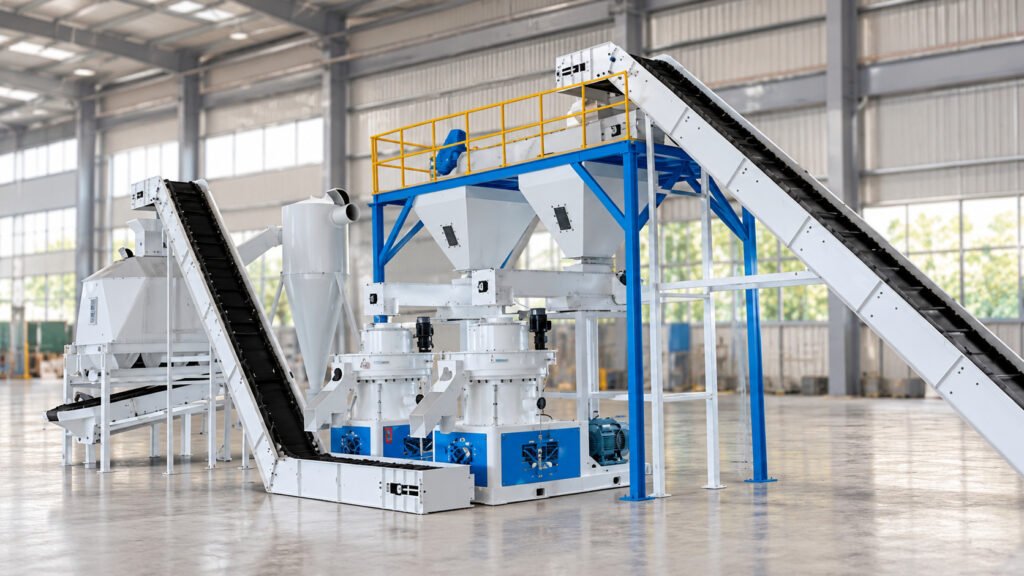
Designing your pellet line with each step in mind will make it easier to control your moisture, particle size and cooling. Manufacturers like Kerone design and manufacture biomass pellet plant systems. These will include cleaning, drying and grinding of your feedstock and pelleting. They can be customized to your feedstock and capacity. The benefit of this is your whole line will have less variables going out of range.
Dust Collection and Safety Are Part of the Design
Fine biomass dust can be flammable so you want to ensure your plant has good ventilation, dust extraction points, good housekeeping and a basic understanding of the risks of explosions. A line with less fines will also be safer and easier to keep clean.
Reducing Pellet Dust Improves Yield, Product Quality and Operating Cost
Fines are a measurable loss so small improvements will add up.
Yield Recovery
To calculate how much you’re losing multiply your fines % by your daily output and price per pellet. If you’re producing 100 tonnes a day and losing 3% due to unreclaimed fines you’re losing 3 tonnes a day. This will add up over the month.
Fewer Rejections and Lower Operating Burden
Having stronger pellets will reduce the risk of rejection and price reductions. You’ll also reduce the amount of cleaning you have to do, reduce the risk of dust and reduce wear on your equipment due to re-circulating fines.
Conclusion
If you’re getting dust from your biomass pellet machine there are several areas you should look at. Dust can occur during preparation of your raw material, increase during cooling and handling and reach your customer due to poor screening. The best way to solve your issue is to take samples from each part of your line and see where your fines are increasing. Solve the issue from here.
It’s rarely just the pellet mill that is causing excess pellet dust. Your feedstock preparation, cooling, handling and screening will all play a part. To diagnosis the issue look at each part of your line.
You want to firstly control your moisture, particle size and cooling. This will cause the majority of avoidable fines. It will be much cheaper to fix than changing your die or mill.
The line will perform best if it is designed as a system. Having compatible equipment throughout will help stop ongoing issues with dust and protect your yield and product quality.
FAQs
1. Why is my biomass pellet machine producing so much dust?
Dust is usually a symptom of a problem somewhere along the line, not only the pellet mill. The most common causes are uneven moisture, inconsistent particle size, worn dies and rollers, poor cooling, rough conveying and ineffective screening. Sampling pellets at each stage is the quickest way to find where fines start.
2. What is an acceptable fines percentage in biomass pellets?
It depends on the market and the buyer. Premium wood pellet standards such as ENplus set strict limits on fines and durability, and many buyers add their own requirements. Check the current standard and your buyer’s specification before setting an internal target.
3. Can wrong raw material moisture cause pellet dust?
Yes. Material that is too dry bonds poorly and crumbles, while material that is too wet forms steam pockets and cracks after the die. Many biomass materials work best at around 10 to 15 percent moisture, but the right figure depends on the feedstock, so confirm it with trials.
4. Does a worn die or roller increase pellet fines?
Yes. As the die and rollers wear, compression drops and pellets become less dense and less durable. If fines have been rising slowly over several weeks, along with lower throughput and uneven pellet length, wear is a likely cause.
5. How does pellet cooling affect dust?
Pellets leave the die hot and soft, and the binder needs time to set as they cool. Cooling that is too fast or uneven creates internal cracks, and pellets that leave the cooler warm and moist break more easily later. Controlled airflow, bed depth and retention time help prevent this.
6. Can conveyors and elevators create pellet dust?
Yes. Free-fall drops, steep chutes, overfilled screw conveyors and high-speed elevators all break pellets. Each transfer adds a small loss, so reducing the number of transfer points and softening the transitions often lowers fines noticeably.
7. How do I find out which stage is creating the dust?
Take samples at the die exit, after the cooler, after conveying and after screening, then test fines content and durability at each point. The stage where fines jump is the one that needs attention first.
8. Can screened fines be recycled back into the pellet mill?
Yes, and this recovers yield that would otherwise be lost. It should be done in controlled amounts, because returning too much fine material disturbs feed consistency and can increase dust.
9. Is pellet dust a safety risk?
Yes. Fine biomass dust is combustible, so ventilation, dust collection, regular housekeeping and basic explosion-risk awareness should be part of the plant design. Fewer fines also make the plant easier to keep clean.
10. Can the right equipment reduce pellet dust?
It can help a lot. When drying, grinding, pelletizing, cooling, conveying and screening are matched in capacity and suited to the feedstock, fewer variables drift out of range, so less dust is created in the first place.